
3D Printed Enclosures, Mounts & Holders
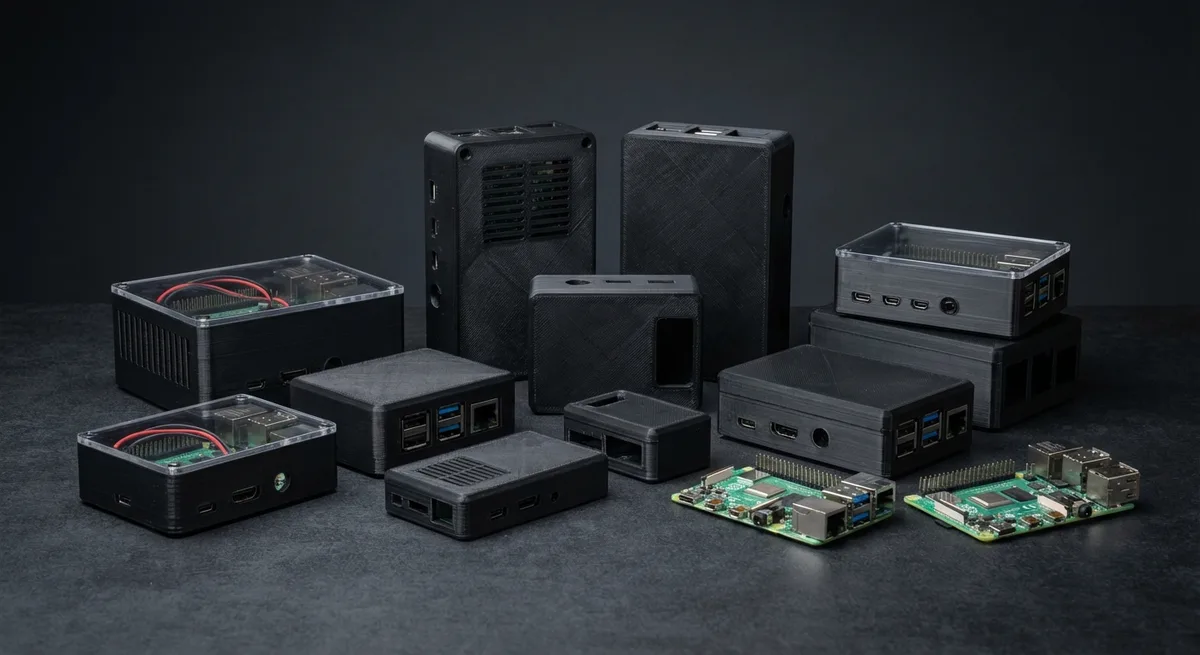
Need a Raspberry Pi case, camera mount or tablet stand? We will print from a ready model or adapt it to your dimensions. We work with the DIY community, makers and regular people who need to neatly house their electronics. Print precision allows us to make snap fits, slots and threaded inserts. An enclosure lives or dies on tolerances. Printing holds about **±0.2 mm**, so we seat the board with clearance rather than flush — otherwise it stops fitting after the first change of filament batch. Screws have two routes: printing the thread directly into the plastic (quick, but it survives only a few tightenings) or heat-set brass inserts fitted with a soldering iron, after which the case can be opened as often as you like. The second is almost always right if anything inside needs servicing. Heat and material are directly linked. If there is a power supply inside, a Raspberry Pi under load, or anything else that runs warm, PLA will deform — use **PETG**, or **CF** for stiffness and dimensional stability. Ventilation slots are best run along the layers, so they print without supports and do not close up. Send the board dimensions, the connectors and their distance from the edge, and that is enough to start.
- ✓ Electronics cases: Arduino, RPi, ESP32, DIY projects
- ✓ Mounts: GoPro, cameras, sensors, LED strips
- ✓ Phone, tablet & headphone stands and holders
- ✓ Cable management: clips, guides, organizers
- ✓ We can modify the model: add holes, logo, mounting points
- ✓ Threaded inserts for serviceable connections
- ✓ Custom enclosure modeling from scratch to your dimensions
- ✓ PETG and CF materials for strength and heat resistance
Enclosures and mounts are what a 3D printer does best. Need a case for a microcontroller, a security camera holder, a cable organizer under the desk — all of this prints quickly, precisely, and costs far less than off-the-shelf solutions (if they even exist for your specific need). We print these kinds of things in Riga practically every day.
For electronics folks and makers: cases for Arduino, Raspberry Pi, ESP32, smart home controllers, sensors and relays. Thingiverse and Printables have thousands of ready models, but often something needs tweaking — adding a hole for an extra connector, changing the height for a non-standard board, cutting a window for a display. We can download a ready model, modify it and print it. Or build an enclosure from scratch to your dimensions — typically 1 day for modeling and 1 day for printing.
Mounts are a whole big topic on their own. GoPro mounts for bikes, motorcycles, helmets. Security camera brackets at any angle. Phone holders for cars, desks, handlebars. Stands for headphones, tablets, laptops. Cable management: clips, clamps, under-desk guides. All of this is printed in PETG — strong, UV-resistant, heat-tolerant, does not crack when flexed.
For load-bearing parts (for example, a monitor arm bracket or antenna mount) we use CF — carbon-filled polyamide that provides strength and wear resistance for parts under real mechanical load. Threaded inserts are heat-set with a soldering iron — creating a reliable, serviceable connection. If you are working on a project and do not know where to start — just describe the task, we will help find a solution.
Recommended Material
We recommend PETG — strong, precise, heat-resistant. For load-bearing parts — CF (carbon fibre).
FAQ
- I only have the board, no drawing
- Measurements are enough: board outline, the diameter and position of the mounting holes, the height of the tallest component, connector sizes and their distance from the edge. A photo of the board on graph paper helps too.
- Will a thread printed in plastic hold?
- For a few assemblies yes, for regular servicing no. If the case will be opened often, use heat-set brass inserts: we press them in and the thread becomes metal.
- Will the enclosure be waterproof?
- No. FDM printing is not sealed by nature — microscopic gaps remain between layers. Splash resistance can be approached with a gasket and a labyrinth on the lid, but we will not claim an IP rating.
- It gets warm inside — which material?
- PETG as the baseline, CF if you also need stiffness. PLA starts to deform around 60°C, and a closed case with a power supply reaches that easily.
Describe your device and task — we will find a solution