Prototype Manufacturing with 3D Printing
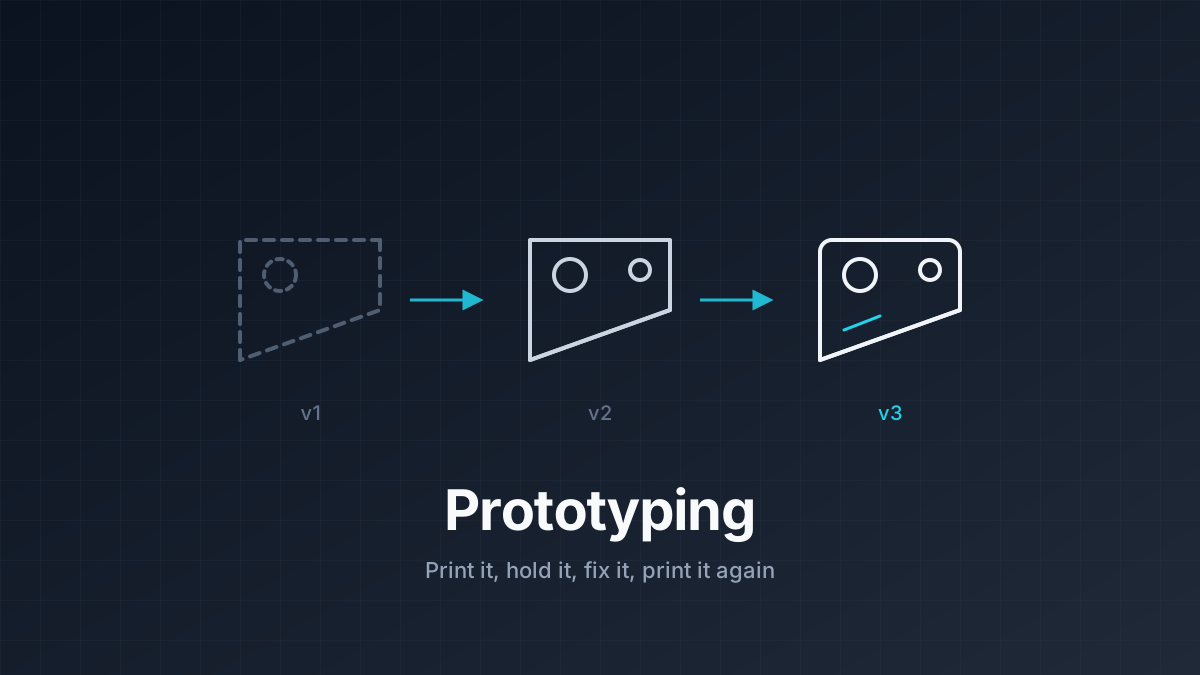
We print prototypes and test parts during development: enclosures, mounts, functional models, fit samples. The point is not one beautiful part but the speed of the loop — print it, hold it, find what does not line up, fix it and print again. A normal iteration takes 1–2 days.
- ✓ One iteration in 1–2 days — a fix in the morning, the part tomorrow
- ✓ Draft versions cheaply: 15–25% infill, 0.28 mm layers
- ✓ Functional samples in PETG, CF and FLEX
- ✓ Part oriented to the direction of the load
- ✓ Discount on variants: 5% from 3 pieces, 12% from 10, 20% from 25
- ✓ Up to 220 × 220 × 265 mm in one piece, up to 100 items per order
- ✓ No model? We will build one from a sketch, drawing or sample
- ✓ We say plainly when a job has outgrown 3D printing
A prototype differs from a finished product in that its job is to tell you something, not to last five years. So the first versions we print fast and cheap: 15–25% infill, 0.28 mm layers, PLA. Such a part costs very little, prints in a couple of hours and already answers the main questions — do the dimensions line up, does it sit well in the hand, does the connector fit. Fine surface work is worth leaving for the final version, once the geometry has stopped moving.
A functional prototype is a different conversation. If the sample has to test load, heat or wear, it needs a working material: PETG for most mechanical jobs, CF (carbon-filled polyamide) where stiffness and dimensional stability matter, FLEX for seals and dampers. We orient the part on the plate so the layers run along the load rather than across it — that affects strength more than the choice of material does.
On iterations and money. The batch discount counts pieces within one order: 5% from 3, 12% from 10, 20% from 25. If you are printing three variants of the same part, send them as one order rather than three — it comes out cheaper and we lay them out on the plate together. The maximum in a single piece is 220 × 220 × 265 mm, up to 100 items per order.
What we do not do: replace injection moulding or promise production tolerances. Printing holds about ±0.2 mm, which is excellent for proving a concept and for a small series, but if you need thousands of identical parts to a hundredth of a millimetre, the prototype is ours and the production belongs elsewhere. We will say so plainly if we see the job has outgrown printing.
Recommended Material
For draft versions — PLA, cheap and fast. For functional samples — PETG, for stiff and dimensionally stable ones — CF, for seals — FLEX.
FAQ
- How long does one iteration take?
- Usually 1–2 days from payment confirmation to a finished part; small draft samples sometimes the same day. The bottleneck is more often editing the model than printing it, so send changes as a list rather than one at a time.
- Can I print three variants and compare them?
- That is exactly what you should do. Send every variant as one order: three pieces already take 5% off, and we lay them out on one plate — faster and cheaper than three separate orders.
- Will a prototype take real load?
- A functional one will, given a working material and the right orientation. Along the layers a part is close to moulded; across them it is noticeably weaker. Describe how the sample is loaded and we will orient it accordingly.
- Can you do a production run?
- A small one, yes — up to 100 pieces per order with a volume discount. Thousands of identical parts to a hundredth of a millimetre is injection moulding, and we will say so plainly rather than take the job and let you down.
Describe the job and send a sketch — we will price the iteration and the lead time